
Highlights: Labor Notes 2010 Conference
Union organizers and supporters don't hold back at annual labor gathering in Michigan
by James M. Flammang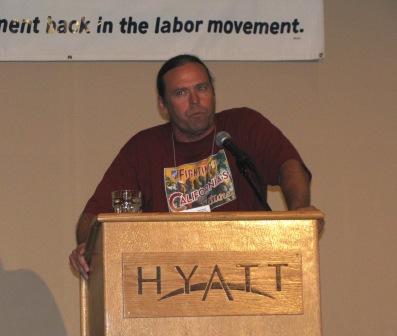
Jim Mitchell, a community college teacher who
walked 350 miles to protest budgetary actions in
California, speaks at Labor Notes conference.
DEARBORN, Michigan (April 23, 2010) - Conventional wisdom tells us that the American labor movement is dead. Or if not dead, well on its way to extinction.
After all, the basic numbers tell the unfortunate truth: Only about 12 percent of American workers now belong to unions. Membership has been shrinking steadily for decades. In the auto industry, for example, every new factory established by an import-brand manufacturer in recent years has been non-union, and virtually all have been erected in southeastern states.
With that reality in mind, you'd expect the folks attending the annual Labor Notes conference to be morose and distressed. Well, you'd be wrong. Glance at the faces of the 1,200 union organizers and labor-movement supporters who attended the 2010 conference near Detroit, and you'd have a hard time finding a frown. Hear their voices raised high, watch their energetic responses to labor speeches and songs, and it's obvious that the labor movement in their eyes remains very much alive - albeit weakened by these decades of decline.
Seldom have we at Tirekicking Today witnessed an event of any sort, dealing with any subject, that revealed such an intense level of enthusiasm, such clear evidence of solidarity, such a heightened sense of purpose and overll excitement. More than once, we felt we'd been somehow carried back to a union hall of the 1930s, when labor was steadily gaining strength in its battle against the bosses, and workers stood together in their struggle for recognition.
Numbers and statistics obviously don't tell the whole story of today's labor movement. People do; and these activist labor people aren't about to let their voices go unheard and unheeded.
Labor Notes supporters call themselves the "Troublemakers." To anyone who's familiar with labor struggles, losses, and victories through American and global history, their presence is heartening - a welcome sight to offset the deluge of negativity about labor that emanates from our newspapers and TV news programs.
These aren't people living out a fantasy from the past, either. Far from it. In nearly every speech, conversation, and workshop, they demonstrate that they are realistic. They're only too aware of the decline of unionism in the United States. They know how unions are being crushed - violently - in various Latin American countries. Yet, they can point to some stunning and heartwarming successes, most of which were achieved by intense, single-minded dedication on the part of scattered groups of unionized workers.
On the whole, they believe in the principles that motivated labor leaders of days gone by. More important, they insist that those ideas can resonate with today's workers - and with the general public - if only they are able to convey the message that labor victories ultimately benefit everyone, not just ardent union members. The "Troublemakers" are working on getting that message out; and if enthusiasm and solidarity count, they just might succeed in the end, despite the seemingly insurmountable obstacles that lie in their path.
Opening Night: Let the Solidarity Begin
"Are we excited?" asked Tiffany Ten Eyck, assistant director of the Labor Notes organization. Applause and cheers were a bit half-hearted at this early point. But as more people drifted into the Hyatt's ballroom and took their seats at this first-night session, the level of enthusiastic response grew steadily. Before long, the bouts of applause began to reach lengthy crescendos, often accompanied by standing ovations.
Several workshops had already taken place that afternoon, but this evening gathering was the first to involve the entire group.
"We have so much to be thankful for," said Rev. Charles Williams, a Detroit pastor who led off the official session, "but we also have so much to fight for." Like most speakers throughout the conference, Rev. Williams drew powerful outbursts of applause with his remarks.
"We need community and labor movement to join together, and work together," Williams advised. In addition, "we need to put the Employee Free Choice Act [EFCA] back on the front burner." Fought vigorously by business interests, EFCA would make it easier for unions to recruit members in a factory or other workplace.
Following Rev. Williams' opening comments, a singing group honored a gentleman who'd helped organize at Ford in the 1930s. "Now you see how they divide us," the lead singer intoned. "Together we speak louder than the machine." Music and song have long been integral elements of the activist labor movement.
"It's really good to look out and not see eight busloads of picketers," said Angela Glasper, representing the National Union of Health Care Workers. "There is a fight in California that we have no intention of losing," said Glasper, who's worked for 23 years as an optical receptionist at Kaiser.
In the eyes of Labor Notes participants, unions aren't invariably beneficent, representing the workers' best interests. "We were a bottom-up, member-driven union," Glasper said. She warned of trouble that had developed with its parent, the Service Employees International Union (SEIU). "SEIU's attacks have been constant," she said, alleging that one SEIU official had declared: "We can't let the members get in the way." Glasper cited as an example of wage disparity the fact that a housekeeper at Kaiser made $23 an hour. Working in convalescent care, a comparable worker would make barely $8 per hour.
John Samuelson, president of Local 100 of the Transport Workers Union in New York City since January 1, also cited problems with his union. First, he said, there had been a reform slate "that failed." Some winners of union posts were prohibited from serving, replaced instead by unelected appointees.
When Samuelson's faction stepped forward, "we made very simple promises," he explained, with the goal of being "member-driven." He sought to end what he calls a "civil war" within his union. "No lofty goals" were needed, he recalled; "just a simple message of democratic reform." Samuelson alleges that prior union leaders had voted to benefit the union president rather than the workers. Power is "on the tracks, in the bus stations," he concluded; not in union headquarters.
Walking 350 miles in 48 days isn't the usual duty of a teacher in California's community colleges. But that's what Jim Miller, representing the Californifa Federation of Teachers, had done just prior to flying to Detroit for the Labor Notes conference. Miller, who teaches English and Labor Studies at San Diego State College, walked from Bakersfield to Sacramento as part of an activist group, to bring attention to the plight of public workers in California. Each evening, he spoke of their protest to local folks along the route, from the back of a flatbed truck.
"Saving the jobs of the entire food service unit against an outsourcing attempt" was a major goal, he said. These efforts "represented a move away from narrow business unionism toward social justice unionism."
To get labor's point across, spokespersons need to talk to "the Rush Limbaugh side," Miller explained, "not the 'blue' folks who already are on your side." His group is "trying to get people angry at the right people," he said, adding that "it's sort of an upside-down world, isn't it?"
Like several other speakers at the conference, Mitchell looked back at labor's heritage, stating that he was reminded of the era of the AFL-CIO, and even the Knights of Labor, which evolved in the 19th century. Many of their ideas are still valid today, he and others suggested.
Mitchell also recalled the Industrial Workers of the World (IWW), which was founded in 1905, garnered considerable publicity into the teens and '20s, then faded into obscurity. Out in the corridor, however, a booth for the modern-day IWW, which has evidently been instrumental in helping to organize certain food workers, was busy dispensing pamphlets and books.
"Unions aligned themselves with Democrats," Mitchell said, "who've forgotten how to talk with working people." His goal is to restore the promise of public education and service, and work toward fair taxes as a means of equitable wealth. "We need to close loopholes instead of schools," he said.
"This is not a problem that cannot be solved," Mitchell insisted. "We reject a politics that puts one set of workers against another." Right now, he advised, there's "kind of invisible Depression in California," adding that they "chase the ghost of Tom Joad" (the famed fictional farm worker from John Steinbeck's novel and film, The Grapes of Wrath). Today, we "need that '30s sense of worker solidarity."
Please click here for additional Highlights from the 2010 Labor Notes Conference: Days Two and Three.