
Highlights: Labor Notes 2010 Conference
Days Two and Three: Labor and Immigration ... What does it take? ... Lessons from labor history ... Auto workers ... Labor and technology
by James M. FlammangUpdated: May 31, 2010
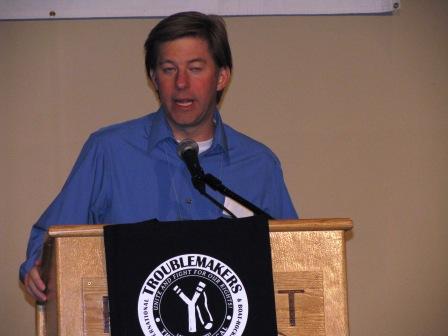
Mark Brenner, director of Labor Notes, speaks
at the organization's Michigan conference.
DEARBORN, Michigan - Day Two at the Labor Notes conference would be filled with workshops, many of them taking place at the same time. We attended at least one in every time period during the day.
Labor and Immigration
Early on Saturday morning, Day Two of the Labor Notes conference began with an Immigrant Workers Strategy Meeting - especially concentrating on the restaurant business. Under 1 percent of New York City's restaurant workers are unionized, said group leader Fekkak Mamdouh, a co-director of the Restaurant Opportunities Center (ROC). But Mamdouh and the ROC are striving to increase the presence of the union movement in the food service field. Mamdouh came to the U.S. from Morocco with a degree in chemistry. Yet, like so many immigrants he could find no work in America, in his chosen field. Instead, he took a job in food delivery, then became a bus boy and then a waiter. He's worked 17 years in restaurants. At one of the restaurants in which he's served, Windows on the World (in the World Trade Center, before the tragedy of September 11, 2001), a waiter could make $100,000 a year. But bus buys earned far less.
He's from Morocco with chemical degree; only job here, food delivery. Then, bus boy. 17 years in restaurants. Waiter where he worked (Windows on the World, in WTC) could make $100,000/year. Everyone in the kitchen was an undocumented worker, Mamdouh told the group. Now, the ROC operates a New York restaurants that employs no one other than immigrants.
"It's not illegal for a person to work in this country," said Billy Jay Randall, who's with the United Truckers Labor Organization. "It's the boss that's the criminal, not the worker. You might not be allowed to be here, but you can work here."
Randall described food warehouse workers in New York, where the warehouses are mostly immigrant-owned and employ all undocumented workers - often, at extra-low pay. Randall mentioned the revived Industrial Workers of the World (IWW), the union formed in 1905 and known in those days as the "Wobblies." The IWW currently is involved with trying to organized the food industry, Randall said - notably Starbuck's.
"Restaurants, they hate protesting," Mamdouh said. Randall suggested a tangible and crucial method of drawing attention to labor unrest. "Stop the trucks and you stop everything," he recommended.
Asked how difficult it was to get media attention to worker issues and organizating movements, Mahmoud replied that it's hard.
What Will It Take?
Talk of restaurant work also led off the session on determining what's needed to strengthen the union movement. Ringo Mack, a hotel server for 20 years, had just returned from a 3-day strike at the San Francisco Hilton. Two years ago, the Blackstone Group bought that Hilton. Now, "they think [workers] should be happy enough just to have a job," Mack said. In his restaurant, management is scheduling three servers and three waiters to do the job of four each before. They're also rolling back health care trying to make housekeepers clean 30 rooms per day. "Affordable health care hardly exists" in hotels now.
"Many of our workers think the union is like an insurance company," he admitted. "We pay the dues, and get the services." Yet, of 850 workers, only 6 crossed the picket line. Because of union efforts, a law-school conference pulled out of the Hilton. "We are tough," he said. "We are organized."
Mark Brenner, Labor Notes director since 2005, was previously an economist. Solidarity means "an injury to one is an injury to all," Brenner said, echoing a long-established union principle. "The labor movement is about fighting for everybody, not just for ourselves."
Brenner reminded the audience that while the federal government claims 15 million workers are unemployed in the U.S., the actual number - taking into account discouraged workers and others who are not included in the official totals - is more like 27 million. He also pointed out that the government spent $4 trillion "backing up the banks," and other $2 trillion on wars. The primary job of President Obama's "car czar," Brenner suggested, was to make General Motors and Chrysler profitable once again. At the same time, the auto industry has been "building a non-union plant right here, in labor's backyard."
President Obama is "kind of doing what he said he was going to do," Brenner concluded. "Change only comes to Washington when it's backed by picketers ... and a whole bunch of troublemakers." What must be avoided is the pressure to "turn the have-nots against the have-just-a-little-bits."
Brenner seeks a "radical increase" in the numbers for organized labor. Only 16 million workers are unionized now. We must go "back to the basics," he said. We need to know "what we're up against," and to realize "that's the way capitalism works."
Learning from the Past: Lessons of Labor History
Because the labor movement - American and global - has such a rich and colorful history, it would seem obvious that today's organizers and leaders must look back regularly upon that heritage while planning current moves. That's not necessariy the case - a lack that Nelson Lichtenstein attempted to address at a well-attended workshop on labor history.
"We did it last time," said Lichtenstein, who teaches at the Center for the Study of Work, Labor, and Democracy at the University of California-Santa Barbara.. "Let's avoid those mistakes" this time. He was referring to labor's successes of the past - particularly during the Great Depression of the 1930s.
Three things are needed to have a successful movement, Lichtenstein explained:
1. Militancy, meaning "a kind of engagement." Opponents should see it as "something unpredictable, something unconrollable."
2. "Ideas which resonate" broadly, not merely to motivate the membership or potential members. Organizers need to concentrate on what makes it "attractive to the rest of society." Not toits enemies, he added; but to those who are neutral, with a goal to "solve a larger social problem."
3. The Law, serving as an institutional framework.
Lichtenstein first looked back at the 1930s - an era of unemployment marches, consumer boycotts, and many other labor-induced actions. Partly due to the economic woes that befell the nation and the world starting with the "crash of 1929," plenty of harsh measures gained popularity in the early 1930s. Many people believed, for instance, that married women should not work. The notion of throw Mexicans out of the country didn't suddenly emerge in 2010; it was a popular idea in the Thirties. "Cultural pluralism" did not really exist yet.
The 1933-35 span, in particular, was a "period of great unpredictability," Lichtenstein explained. Underneath, though, the motivating idea was "a sense of industrial democracy." In fact, the theme of the time stated that "industrial work is the core of the economy." Service work was considered less significant - a far cry from today's situation, where factory employment has shrunk to unprecedented low levels.
The "Wagner Act came out of the experience of the militant workers in 1933, 34, 35," Lichtenstein said. President Roosevelt wasn't a fan of that Act, which helped give workers the right to engage in labor actions. The Wagner Act "worked for a while," Lichtenstein said. However, "over time,the economy changes, but the law stays the same."
Roosevelt and others in his Adminstration wanted a "mechanism to satisfy the workers and stop the strikes" that were plaguing the country - a curious phenomenon considering the overall economic turmoil, in which those who had jobs were typicaly unlikely to do anything to jeopardize their standing.
Corporations suggested "company unionism," Lichtenstein said. Right-wing rabble-rousers such as Father Coughlin, the reactionary Catholic priest from Michigan who had become a radio superstar for his fiery diatribes against Roosevelt and the New Deal, favored that means of dealing with labor.
Lichtenstein cited several examples of labor activities that missed one or two out of his list of three "ingredients" for success. In the 1960s, the United Farm Workers staged a long-term boycott of grapes in response to actions by the grape growers in the southwest. Cesar Chavez, the UFW leader, was charismatic, Lichtenstein said; but he faced a lot of problems with administration of the union itself. In terms of law, then, the farm workers' action was "kind of a failure."
The 1980s and '90s saw "tremendous examples" of activism, according to Lichtenstein, equivalent to the Pullman Strike of the 1890s, the 1919 Steel Strike, the Homestead Strike, and other milestones of labor history. "They were not wrong, but the ideas did not resonate." People said, "this doesn't accord with Reagan's America."
More recently, "ideas were there" at the labor action taken by laid-off workers at Republic Windows and Doors in Chicago, at the end of 2009. Militancy was part of that movement, too. But the law was not on their side.
Moving on to the 1960s, Lichtenstein noted that the "Civil Rights movement was often in great tension with the labor movement." Essentially, the Civil Rights Movement "was a movement to restore democracy." In addition, "people of color were in public employment" (which was not covered by the provisions of the Wagner Act). As initiated by President Roosevelt during the Depression, the Wagner Act excluded public workers and farm workers..
Lichtenstein recalled telling an American Federation of Labor (AFL) convention that labor, during a Democratic Administration, should be a troublesome and unpredictable ally. As an example, he cited the old Communist Party. Even if those folks wee "terribly wrong," the Communist Pary had both militancy and ideas. President Obama's Administration lacks a comparable organization prodding it. What's needed today is an idea that could motivate a broad mass of people, beyond simple increases in their standard of living, to deal with the "huge imbalance" that prevails.
"Strikes are important," Lichtenstein advised, because "they create a sense of crisis." Regarding the auto-company bailout of 2009, the United Auto Workers Union failed to clarify the point that benefits would accrue to Americans in general, not just UAW workers.
One audience member named Victor, from the Communications Workers International, brought up a critical point. "Many of us don't think of ourselves as citizens," he said. "We think of ourselves as consumers." That's not good news for the labor movement, or for democracy. Another attendee, a self-described Socialist, warned that the "idea of militancy has to be rebuilt. Those ideas have to be won back."
Ned Burke, a Chicago labor lawyer, noted that "they go from being lonely little ideas to being [big] ideas. that resonate. How do we know when these ideas are ready to pop?"
Lisa, a communications worker, at UC Berkeley, suggested the need to make the big ideas more accessible - almost like the "lowest common denominator," but more positive. Labor, she added, should be "communicating in a way that people understand.... I think surprise is a great thing," she concluded, recalling that the Republic Doors & Windows action in Chicago had "surprised people."
People are angry all over, another woman in the audience summarized, including the Tea Partiers. Capitalists are really good at identifying enemies, she said. "We need to be better at that, with our own enemies." As one example, a gentleman from the University of Illinois recommended focusing on "the idea of a livng wage. That's one that resonates to people."
Labor in the Auto Industry
Considering that the Labor Notes conference was held in Dearborn, Michigan - the global home of Ford Motor Company and only a few miles from the headquarters offices of General Motors and Chrysler - an auto workers' presence makes perfect sense. Actually, 11 separate union meetings took place on Saturday afternoon, drawing workers in the building trades, transit, longshore and telecom, as well as the United Electrical workers, postal workers, public employees, nurses, and teachers.
At the United Auto Workers' meeting, Bill Parker, president of Local 170, recalled the eight plant closings that were announced back in 2008. Not one was in Canada or Mexico; all were U.S. factories. The auto "industry is suffering from tremendous overcapacity," he said. "Every plant was having to fight on its own for survival." Moving closer to the present day, "bankruptcy came too quickly," he added. So, the UAW was unable to warn that if you close plant A, you won't produce any cars anywhere. A Ford representative stated that in his plant are workers from 30 other Ford plants.
A GM union representative briefly summarized the growth of the current two-tier wage system, with no COLA (cost of living allowance), no pensions, and no retiree healthcare benefits for new hires. He also pointed out that GM has opened a non-union plant to produce batteries for the forthcoming Chevrolet Volt extended-range electric car - right in Michigan. UAW membership is now at levels that were unseen since 1940, he said. A new electric motor plant in Baltimore will be a UAW factory; but it's called a standalone plant, so the new low wages are the rule.
Rodney Childs, an employee of Delphi (a top supplier to automakers) expressed his concern for the younger generation. "They don't have a future if we don't stand up now," he warned. An audience member echoed Childs' concern, suggesting that young workers know nothing, but are "hungry for information on unions."
Retirees also have a voice in UAW matters. "When people are working we have less crime," said a retired workers named Bob. Drugs are less prevalent, too. "We sat back on our asses and let it happen," he insisted. Now, we need "laws that reflect our needs, and not the needs of corporations."
Looking at the recent furor over health care reform, the retired gentleman stated that tax dollars now pay 60 percent of healthcare costs. If you take away profit, all can be covered. In his view, people were tricked into believing insurance card is the only way to pay for health care.
Following the union meetings was a Global Auto Roundtable, with guests from several countries. In Europe, like the United States, "dramatic overcapacity of production" is a critical issue, according to a union leader who works for Daimler in Germany. In the past two years, he's also seen shift to production to other countries - again, echoing the U.S. experience with outsourcing..
Ed Cubelo, president of the Toyota Motors Union (the Philippine Workers Association) said that in his country, the average regular auto worker earns $18 a day. Contract workers get only $6 per day. Being a union leader in the Philippines can be risky. Early in 2008, Cubelo recalled, the military was searching the union office for union leaders. Soon, 21 illegally-dismissed workers (including him) were jailed. He was released from jail due to international protest.
Rikimasa Ichikawa, general secretary for the Isuzu Motor Union in Japan, said that earlier in his 43-year stint with the company, they had two levels: temp workers and regulars. In 2004, the regulation changed. There are still two types, but they're temps, and contract workers. Under Japanese law, contract workers are called each day; and told whether to come in. It's called the "registration system." Some 70 percent of workers at his plant are temps.
Young-Ho Lee, from the Metalworkers Union at Ssangyong Motors in South Korea, brashly described last year's 77-day sit-in strike as "against the brutality of capital" For the past 10 years, he said, unions have "often cooperated with the government." Reconstruction involves layoffs and hiring temp workers, and companies have been "employing murderous repression on the union workers." To restore some equilibrium, he concluded, they need to restore "independence, morality, and fighting spirit" to union.
Evening Banquet
On Saturday evening, the Hyatt's huge ballroom was filled to capacity with Labor Notes members and supporters as a woman sang one of the most noted union songs from the past: "Which Side Are You On?" Elise Bryant, representing the National Labor College in Detroit, recalled early labor leader Samuel Gompers' dream of 1886. Then, she removes the colorful African gown she'd worn onstage, to reveal a Troublemakers T-shift.
An exuberant and lively Lynn Marie Smith (known as The Motown Diva) ambled around the audience's dining tables as she sang of "part-time workers." Smith had come up with new union-related lyrics to a number of familiar tunes - even "YMCA," once made famous by the Village People.
After dinne,r Labor Notes honored six groups and one individual with Troublemaker Awards:
1. The Hyatt 100, which has been on strike against three Boston Hyatt hotels and initiated a boycott. A spokesperson explained how the hotel chain had "tricked" housekeepers into training their replacement, and wanted to cut wages by half.
2. UE Local 1100, Republic Windows and Doors. Unlike most labor actions, which get little or no publicity, the sitdown called against this Chicago company after it announced a permanent plant closure drew plenty of national publicity.
(Session leaders called for a moment of silence to honor the coal miners who'd been trapped in an explosion earlier that week.)
3. Colombian coal miners who works for the Drummond Coal Co. Since 2001, two union presidents have been killed. Seven attempts on the life of the current leader, Mr.. Ramirez, have taken place in what he called "capitalist terrorism."
4. Steelworkers' Local 6500 - nickel and copper miners of Sudbury, Ontario, Canada. These miners went on strike against Inco Vale after what they called "record" concession requests. Workers went to many countries to promote their cause. A new contract in March 2010 was no better, so they burned it on the streets of Sudbury, when 89 percent of workers voted it down. "United we stand, divided we beg," said a spokesperson "One day longer, one day stronger."
5. ILWU Longshore Local 30, of borax miners at Rio Tinto in California. Last winter, they received what they considered an "outrageous contract offer." The mining company sought the ability to demote workers anytime, and to outsource at will. In January, the 560-member local rejected that offer. Gates were locked, with scabs taking the regular workers' jobs. "Now we have a plaque that proves we're troublemakers," one of the miners told the Labor Notes audience.
6. Miners Local 65, from Sonora, Mexico. Copper miners were one day short of their 1,000th strike day against the Cantanea company.
7. Charley Richardson, a respected labor educator and former shipfitter.
Day Three
Labor Media Today
In decades past, many newspapers and magazines employed journalists to cover the labor beat. Today, few work in that capacity. Marty Conlisk, who operates Laborbeat on cable-access TV in Chicago, is even more pessimistic. "There are no labor reporters in America," he told a Sunday morning audience gathered to learn how the media can be used to get out the labor message.
Chris Lawson, who works for the Public Service Alliance of Canada and serves on the LabourTech organizing committee, explained how publishing is changing dramatically and rapidly. "Stop thinking about newspapers, radio, TV," he said. Instead, think audio, video, text. Because the ways of delivery news and commentary have changed.
Session leader Steve Early, who does work as a labor journalist, pointed out how the workforce in general is changing, eliminating permanent full-time employees in favor of contract workers and freelancers. "They want what they call the virtual employee," he said: people who work at home, via an agency, and are not considered employees at all. As a warning, Early also recalled the situation faced by many workers in South Korea, who are "on call," never knowing from one day to the next whether they'll be putting in a day's work or not.
Technology and Labor
<[>According to this session, led by labor educator Charley Richardson, employers are taking advantage of the latest technology to engage in intesive surveillance of many workers. One glaring example is UPS (formerly called United Parcel Service). Craig Karnia, a UPS driver from the Teamsters Local 705 in Chicago, explained that technology is used not only to track every package that's delivered, but also to track the drivers. All along the route, managers can determine whether a given driver is "over" or "under" his schedule. They can check how the truck is driven and used. They know if two doors are open, if the truck (dubbed a "package car" by UPS) is backing up, and far more - some 400 different factors are tracked, many of them based on information that's put into the electronic clipboard that all drivers use constantly nowadays."Stops have gone up per hour," too, Karnia said. That's startling news to anyone such as myself, who long ago worked for a brief time as a UPS driver. Already in those days, the schedule was brutal.
"Telematics has introduced such a flood of information into UPS," said one audience member. Now, they're starting to cut out management as well, in favor of "virtual management."
Nurse Debra Rigiero, from the Massachusetts Nurses Association, told the audience how hospitals are using Lojack - a technology best known for tracking stolen vehicles - to keep track of nurses o their rounds. Rigiero also noted that there are places where workers can bid online for overtime shifts; and management takes the lowest bid.
Finale for 2010
<[>A pair of enthusiastic folk singers, Anne Feeney and Abby Green, led the final presentation on Sunday. They were followed by a panel discussion entitled "Together We Win," featuring a labor leader who can count some particular impressive successes.Lucas Benitez, originally from Guerrero, Mexico but now active in the U.S., is a co-founder of the Coalition of Immokalee, organizing workers from Mexico, Guatemala, and Haiti. His group secured the first wage increase for tomato pickers in 20 years. Yet, there are still thousands who make just 40 to 45 cents per 32-pound basket - the same pay as in 1978. No benefits come with that pittance, either, and these farmworkers remain excluded from National Labor Relations Act.
Benitez's group initiated a "strong campaign [that] got McDonald's to the table. Then Burger Kind, then Subway, then Whole Foods. And more." Today, eight of the largest food companies have signed agreements. Now, the group is "asking the supermarket chains to come to the table." Benitez's group operates a Consciousness Mobile Museum, inside replica of a wagon that once held workers as slaves.
For anyone who backs the labor movement, the Labor Notes conference was disappointing in only one respect: insufficient time. Dozens of additional workshops were held during the three-day program, but attending more than one or two at a time is obviously impossible. Although the Labor Notes organization has been active for 31 years, not that many people outside the movement are familiar with it.
During the conference, Some Labor Notes speakers were even more incendiary and alarmist than their brethren. "This country is on a powder keg," said labor journalist Steve Early. A mass movement is coming. "Basically, the young people have no future."
Today in America, unions represent only 12 percent of the workforce. Chris Lawson, of the Public Service Alliance of Canada, suggested that a lot of young people believe a "union is the kiss of death to their career." So they shun the labor movement. "Until they need it."
Return to Day One of Labor Notes conference.