
 CLICHY, France - Paris may be known for its bright lights and busy life, but Clichy is quiet. Famed expatriate author Henry Miller, who lived here in 1932-34 to write the banned novel Tropic of Cancer, called his autobiographical tale about that period Quiet Days in Clichy. That's still an apt description of this small residential community, which starts just north of the Peripherique, the beltway that surrounds the city of Paris itself.
I'm here to try and follow a bit in Mr. Miller's footsteps, all these decades later. Specifically, I decided to give Paris a try as a place to work on some of my speculative book projects. During the past several years, Mexico has served that purpose. In late winter/early spring, that's been my principal destination simply because I was always able to think more clearly and imaginatively in Mexico.
Ever since I first visited Mexico in 1974, it's been a special place: a country where just about every time you turn a corner, there's something interesting to see. This was especially true when residing for a month in San Cristobal de las Casas, in the state of Chiapas, as described in several of our True Travel stories....
This year, however, I decided to investigate alternate possibilities. During the online research, I came across an organization called Airbnb.com, which matches available apartments, rooms, and homes with people looking for such accommodations, all around the world. As a result, I rented a room with a married couple in Clichy, just north of the Paris city limits. In addition to the room, my hosts provide dinner each evening, which eliminates the need to go out to restaurants late in the day....
Click for complete Clichy story
 Judging by the seemingly endless walk required to reach the entry point to the Palexpo convention center from the airport and its internal railway station, first-time attendees had to assume that the Geneva International Motor Show is gigantic inside. Not exactly, even though exhibits are set up in six Halls. Unlike the auto shows in Paris and Frankfurt, however–where visitors must trudge between separate buildings–the Geneva event takes place mainly in one huge structure, with no barrier between the Halls. Some Halls are on the upper level; the remainder on a lower level. But strolling from one end to the other certainly isn't an all-day affair.
International auto shows in those three European cities strive hard for attention. Frankfurt and Paris present auto shows in alternate years, whereas Geneva, Switzerland has one every year.
This year, the Geneva event opened to the Press on March 6, and to the public on March 8. Organizers promised some 140 world and European premieres, from a total of 260 exhibitors. As many as 10,000 media visitors were expected, from 80 countries, to attend almost 70 news conferences (about 45 of them held by automobile manufacturers)....
Click for complete Geneva Motor Show story
 Early in 2010, we were so taken with this easygoing colonial city in a two-week stay, that we came back again in 2011 for more than four weeks. Not much is different from our year-ago report. A few restaurants have disappeared, and others have sprouted. One of the two movie theaters - small ones that project older DVDs on a screen - moved to a new, more convenient location. A conventional cineplex has opened, but we haven't seen it as yet because it's a bit of a distance from the historic center. That's where we spend nearly all of our time.
Zocalos (main squares) in most Mexican cities and towns are lovely places, and the one in San Cristobal is among the most compelling. Surprisingly comfortable iron benches are spread around the square, inviting passersby to stop for a few minutes, or even a few hours. Most of the time, music is playing: recorded songs in the daytime, and live music at night. Evening musicians play on the upper level of the central bandstand (downstairs is a small cafe). Now and then, a separate set of musicians or performers sets up at the edge of the Zocalo, but nobody seems to mind the conflict between sounds....
Click for complete San Cristobal story
 NEW YORK CITY - As the oldest auto show in the country, the annual New York event has quite a heritage to look back upon. The show also generates high expectations.
As this year's show opened to the media on Wednesday, April 21, those expectations were particularly strong. Show organizers were claiming there would be 56 new-model introductions. Quite a few were global, though other vehicles were appearing for the first time in North America, having been seen previously elsewhere.
Compact cars scored well at the auto show, with seven freshly redesigned models getting their first appearance to the public. Fiat introduced the new Cabrio (convertible) version of its 500 microcar. Rather than a conventional convertible top, the 500 Cabrio has a sliding fabric roof, virtually identical to the sliding roofs used on Fiats (and other European small cars) back in the 1950s and '60s....
Click for complete New York Auto Show story
 VERACRUZ, Mexico - Never a quiet city, at least in the central historic district and along the malecon (waterfront), Veracruz goes all out at Carnival time. Introductory parades for the 2011 Carnival began on Wednesday, March 5, rolling down Avenida Independencia and passing the always-lively Zocalo (main square).
These launch parades took place for three evenings, giving visitors an opportunity to get an up-close view of the king and queen of Carnival, as well as hundreds of dancers and musicians. Those women who weren’t wearing striking costumes were clad in gorgeous evening gowns, some with trains that followed them by six feet or more. The first parade featured Veracruz children, who looked to be just as enthused–and nearly as adept at parade behavior–as their adult equivalents.
Don’t want to stand along the sidewalk to view these evening extravaganzas? No problem. Just pay 20 or 25 pesos (around $2.00) for a seat, on one of the hundreds of reserved folding chairs set up for the occasion. That way, you get an unobstructed view of all that passes, while enjoying a reasonably comfortable seat. Loud, intense, and unabashedly colorful, these early evening parades last 30 or 40 minutes each.....
Click for complete Veracruz Carnival story
 CHICAGO - As automobile sales faltered over the past several years, major auto shows suffered comparable shrinkage. Detroit's North American International Auto Show, while retaining the lead among U.S. automotive events, diminished significantly in 2009 and 2010. This year, the Detroit show was smaller yet in terms of new-model introductions, which took place in a single long day rather than the two-plus Press Days that used to be the norm.
Both the New York and Los Angeles auto shows have been gaining in stature compared to Detroit, but they, too, have slimmed down somewhat. None, though, has exhibited the level of dwindling that's been evident at the Chicago Auto Show, held each February.
At this year's Chicago show, only eight automakers held news conferences for visiting journalists, versus 19 in Detroit in more than 20 in Los Angeles. Not quite all of those manufacturer announcements qualified as earth-shaking, either. As they have for the past two years, Chicago show organizers hosted a second Press Day, but it was set up for the benefit of social media rather than the traditional journalists who used to be the mainstay of reporting on the automobile business.
Showgoers who hit McCormick Place during the 10-day public period of the show, on the other hand, will be impressed by the vastness of the space and the number of vehicles - a strong point of Chicago's event. This year, the floor space is even bigger than before, and four indoor test-drive tracks are set up to let visitors ride in new vehicles....
Click for Complete Chicago show story
 DETROIT – Searching for a hint of disappointment or displeasure at the North American International Auto Show was a bit like seeking evidence of a 100-mpg automobile on a show floor filled with performance cars. An occasional critic might be found among the 5,000 journalists and industry leaders who crowded into Cobo Hall for Press Day, but the words most often heard were "momentum" and "excitement." Just about everyone appeared to believe that the American auto industry was back in action, after two sagging years, and the Detroit extravaganza served as hard evidence of its return to prominence.
No doubt about it, some of the new and redesigned models introduced in Detroit, and placed on display for the general public, are vehicles to be admired and respected. After all, 19 major automakers held news conferences at the Detroit show, launching more than 30 distinct models.
On the other hand, 13 automakers didn't consider Detroit to be worth the expense and effort of holding a news conference for journalists. Most of those companies have exhibits at the show - some of them relatively elaborate - but either had no new products to unveil, or were holding them back for release later in the season, at the Chicago or New York auto show....
Click for Complete Detroit show story

LOS ANGELES, California (November 17, 2010) For the past several years, the Los Angeles Auto Show has waged a quiet war against Detroit for the title of top auto show in the country. It's an unofficial war, and the only battles are the number of new-model introductions and attendance figures - for both the press and the general public. Still, both sides consider themselves to be Number One. So, for that matter, does the Chicago Auto Show, which arguably has the best venue of the trio, but for the past couple of years hasn't provided nearly as many vehicle launches as in the past.
New York, the fourth contender, hosts one of the most active auto shows, but it doesn't take place until just before Easter each year. Nowadays, the fact that Los Angeles holds its auto show in November, versus January for Detroit and February for Chicago, is a point in its favor.
Before the 2010 show opened, the Los Angeles organizers were promising more than 50 new-model debuts (either global or North American). That's an impressive total, making Los Angeles one show not to be missed this fall. More than 20 major manufacturers held news conferences during the two-day Press Period, along with several lesser-known makes. ...
Click for Complete Los Angeles show story
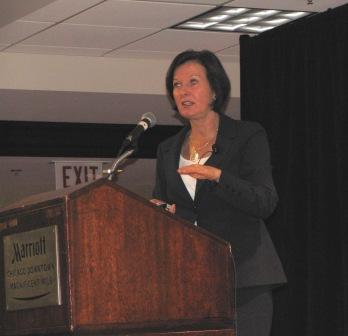 CHICAGO - "Right now, we are just at the beginning of a recovery in terms of jobs," said Ford's chief economist, Ellen Hughes-Cromwick, adding an expectation that consumer income will "rebound in the 3 percent range." Speaking to a small group of journalists in May, just prior to the first-ever Automotive Economic Forecast and Financial Forum, Hughes-Cromwick noted that she was "supportive of an economic pace in the 3.5 percent range."
"We’ve seen a lot of stabilization in the credit markets, the finance market," Hughes-Cromwick said. "Some of those people will eventually be able to get back into the market." For now, "they’re only just starting" to feel confident. There's not yet a "normal appetite for consumer lending." Banks remain cautious about lending, and potential shoppers who are concerned about a job aren’t likely to come into the showroom....
Asked about the prospects for smaller cars, she said: "I think it’s going to be very interesting" to see what happens, adding that "good fundamentals support that." Especially among the young, she can see "interest in a smaller package," and not just during a $4/gallon gasoline period. "I think we will see a variety of demand in the marketplace," she advised. "We know that there’s a variety of buyers out there."
About 60 countries are at "takeoff stage" now in terms of development, Hughes-Cromwick said, and China is far ahead of the pack. Including heavy trucks, China is selling 14 million vehicles per year. At this point, two regions out of three in China "have achieved that per capita income" where vehicle purchases are possible. It takes the equivalent of $15-17,000 per year. After that level, "vehicle sales begin to slow."
In her presentation at the conference itself, Hughes-Cromwick noted that "we were the epicenter of the subprime disaster" but "we are in a global recovery." However, a 2008 consumer expenditures survey by the Department of Commerce found that 44 percent of consumer spending was done by households with $100,000 income and above. ...
Click for Complete Economic Forum story
 NEW YORK - Strolling the auto-show floor and listening to industry executives, an observer could be excused from thinking that virtually all the troubles faced by the automobile business over the past year have disappeared. Or, at least, they’re well on their way to extinction. In contrast to comments made at Detroit’s North American International Auto Show in January, where practically everyone spoke about “new beginnings,” hosts of the press conferences in New York demonstrated a remarkably upbeat note - as if that new beginning has already begun and is proving itself.
Compared to the Chicago Auto Show this past February, New York's event yielded a lot more introductions. Some two dozen global or North American premieres of new or redesigned models took place, presented by 16 major manufacturers. Two notable additional new models were exhibited on the show floor, after first being seen at off-site events.
Alan Mulally, the president and CEO of Ford Motor Company, led off the first of two Press Days at the New York show, serving as keynote speaker for the annual breakfast hosted by the Greater New York Auto Dealers Association. Mulally outlined four steps that Ford needed to take to avoid financial disaster: 1. Restructuring ... 2. Accelerate product development ... 3. Finance the plan ... 4. Pull all resources of Ford, from around the world
One big step involved focusing on the Ford brand, divesting all non-core assets. Mulally pointed out that the Ford, Lincoln, and Mercury brands accounted for 85 percent of sales, so the loss of Jaguar, Land Rover, Mazda, and Volvo wouldn’t be a monumental change.
As a result, “If you want to be in the automobile business,” Mulally said, “it’s really cool to be Ford.” ...
Click for Complete New York Auto Show story
 The scramble to purchase new autos after World War II demonstrated how firmly entrenched the automobile had already become. Before the war, more than 29 million cars traversed the roads, owned by slightly more than half of American families. During the years following Allied victory, with cars again rolling off the assembly lines, those ownership figures rose steadily. Many who had managed without a car throughout the Depression now felt deprived without one; and returning veterans typically put a brand-new vehicle high up on their lists of goals.
Not surprising, then, is the fact that 1950 was a record sales year. Better than 6.6 million new autos found their way into the hands of eager buyers, bringing the number of registrations over the 40-million mark. It had taken a couple of years for the industry to catch up with demand, but by 1950 most folks who craved a new model could get one - provided they could pay for it. Imported cars like Swedish-built Saab 93 (pictured) began to attract buyers in the mid-1950s, but Detroit's "Big Three" and a few independent domestic makes ruled the American market.
Sales dropped somewhat in the next couple of years, though remaining healthy enough. Not until 1955 did another boom arrive, setting sales records that would endure for the next decade. An astonishing 7,920,186 new cars were sold - up 42 percent from the previous year - with seven out of ten families now enjoying the pleasures of auto ownership and spreading joy throughout the offices of Detroit. ...
Click for Complete 1955 story
 DETROIT - Ever since 1989, Detroit's auto show - held in January at Cobo Hall, along the city's riverfront - has been called the North American International Auto Show. That was the year when the show gained international recognition and official endorsement. Prior to 1989, the show had served as a local event. Thus, it was far less notable than the Chicago and New York auto shows, despite the critical importance of Detroit to the auto industry, dating back to the early days of the automobile.
In years past, 6,000 to 7,000 journalists have squeezed into Detroit's Cobo Hall, to the point that news conferences turned into stifling ordeals. This year, the difference was dramatic. Seats often were available, and exhibit spaces had significantly more elbow room.
Show promoters had promised some 40 world and North American premieres of production and concept vehicles. On January 11 and through the morning of January 12, a total of 17 major news conferences were held. Smaller auto companies hosted five media presentations on Day Two, along with several suppliers and other organizations. ...
Click for Complete Detroit show report
 CHIBA CITY, Japan - Known for years as one of the premier auto shows of the world, Tokyo's annual event diminished substantially this year. At the 2007 show, nearly three dozen manufacturers from a variety of countries exhibited passenger cars. In October 2009, only 11 passenger-car makers set up displays, and all but three were Japanese makes. The three exceptions were European niche manufacturers that produce performance cars: Lotus, Caterham, and BMW Alpina.
Hyundai was scheduled to appear but cancelled those plans a few weeks before opening day. That meant no cars from South Korea, China, or North America. In fact, early in 2009, show organizers had considered abandoning the Tokyo event entirely. That's exactly what happened in Barcelona, Spain this year.
Because Tirekicking Today had not covered the Tokyo show before, some might think this was a strange year to cross the Pacific for the event. Because of all the turmoil within the automotive world, though, it's by no means certain that another opportunity will emerge. More important, Tokyo's show turned out to be as fascinating as expected. While similar to the European and major North American auto shows, Tokyo's version possesses its own character and a touch of delightful quirkiness, most evident in the concept models. ...
Click for Complete Tokyo show report
Suddenly, the lead car slowed, as a heavily-loaded truck came into view ahead. Each car in line dropped its speed swiftly. Along the right side of the sinuously curvy road, a sheer rock wall reached toward the sky. At the left was forest land. In between, a double yellow line separated the lanes, because it was impossible to see far enough ahead to pass with even the slightest degree of safety. As everyone knows, or should know, that double line means "No Passing." Period.
That knowledge didn't deter the group for long. After little more than a moment's delay, the lead car swung across the double-yellow, abruptly downshifting and tromping the gas pedal to roar past the truck. Seconds later, car two followed. Then the third vehicle. Car four managed to make it past the truck, too, without encountering an oncoming vehicle. Pure chance, because there was absolutely no way to know if anyone was coming toward you, hidden behind the truck.
I was in the fifth car, but wasn't about to cross that double-yellow barrier. Chances are, the sedan would have made it past the moving obstacle. Up to that point, few oncoming cars had appeared. But that didn't matter. Unlike my colleagues in the front cars, I had learned long before and still accepted the simple fact that ignoring a "no passing" warning was foolhardy and ignorant. Not to mention illegal - and just plain wrong.. ...
Click for Complete Chapter
Well, what's happened to GM, Chrysler, and Ford over the past nine months or so is nothing if not interesting. A year or two earlier, it would have been virtually unthinkable to utter the word "bankruptcy" in the same sentence with any of the immense "Big 3" automakers. Ever since the early days of the automobile, these behemoths had been financial giants, fully able to withstand the inevitable, challenging winds of economic change. Hadn't they?
Now that the axe has fallen on GM and Chrysler, in particular, many if not most observers assert that the decline for each corporation began long before the financial crisis that developed during 2008. For years, all three Detroit automakers had focused their attention on trucks - especially the increasingly popular SUVs, including the full-size models that sucked up gasoline like an off-duty sailor might consume cold beer. ...
Click for Complete Editorial
Listening to many auto-industry observers comment on the GM bankruptcy, you'd think President Obama and his Task Force boldly blazed their way into Detroit to confiscate an unwilling industry. They make it sound almost like President Truman taking over the steel industry during the Korean War. In their frenzied estimation, those big, bad government functionaries leaped in with a heavy foot to rule an industry they know nothing about, simply because they could; and to some frantic eyes, because they ultimately sought to destroy the capitalist system.
Have we forgotten so easily those harried days last fall, when GM executives and their compatriots at Chrysler and Ford flew privately into Washington, virtually hat in hand, to plead for government funds? Neither then-President Bush nor anyone in government, then or later, invited them to accept bailout billions, much less ordered them to do so. Having watched their corporations sink close to the breaking point, they went to Washington as an act of desperation, seeking infusions of cash to stave off the financial vultures for a while longer....
Click for Complete Editorial
Judging by the evident interest in environmental issues, you'd think we were all taking steps every day to make our world a better place.
Many of us are. Millions of Americans do take those small steps in their daily lives, which add up to a big difference - whether it be shutting off unneeded lights, driving less, or recycling trash. Plenty of profit-making organizations really do take environmentalism seriously, and alter their plans and products accordingly. Best Buy, for instance, has recently earned credit for "green" initiatives - and was permitted to exhibit at the 3rd annual Green Festival in Chicago, in mid-May 2009. They demonstrate that a corporation can be green and profitable at the same time.
For many, though, the claims ring false.... Click for Complete Editorial
In some parts of the country, red light cameras seem to have emerged at every other corner. In other areas, they're far less common - at least for now.
Considering how many people have complained about receiving these photo-generated tickets, you'd think they'd be outraged by the presence and use of such devices. At least theoretically, after all, a flagrantly lawbreaking motorist could receive a stack of such violation notices after a single day's driving.
Evidently, they're more popular than they'd appeared to be. In a recent voter survey by Public Opinion Strategies, motorists expressed a surprising level of approval of the red light cameras. Some 45 percent of respondents said they "strongly support" the use of camera to detect red-light runners at the most dangerous intersections, and 24 percent "somewhat support" the devices. Only 18 percent said they "strongly oppose" their use. Even more interesting, almost half of respondents believe that other people in their state oppose red light cameras, in contrast to their own support....
Click for Complete Editorial
Compared to the Chicago Auto Show this past February, New York's event also came across as a lot bigger. Show organizers counted 35 global or North American premiers of new models, presented by 16 major manufacturers and a couple of lesser-known companies. Many of the introduced models were bigger and more powerful than their predecessors - though typically promising improved gas mileage.
Stefan Jacoby, the president and CEO of Volkswagen of America, led off the first of two Press Days at the New York show, as keynote speaker for the annual breakfast hosted by show organizers and the International Motor Press Association. "All Americans have a stake in this industry's future," Jacoby said, while predicting that U.S. vehicle sales will fall below 10 million vehicles in 2009. "We cannot expect overnight improvements."....
Click for Complete Report
Could the legendary Big Three automakers mutate into a slimmed-down Little Two - or, horrors, even shrink to a single survivor? Namely, Ford, which appears to be on more solid financial footing than its Detroit rivals?
Surely, the ghosts of such early industry giants as William C. Durant and David Buick must be in a state of turmoil these days. Almost a century ago, in 1908, Durant established General Motors, folding in such rising-star makes as Cadillac, Buick, Oldsmobile - and later, Chevrolet. Over the ensuing decades, GM evolved into the global powerhouse of the auto business, assumed to be virtually impervious to machinations in the marketplace.... Click for Complete Editorial
Who will buy all those new (and used) cars if lenders limit loans to the supremely credit-worthy?
(February 7, 2009) Buying cars on time has been the rule for so long, it's difficult to recall that there was a time when nearly everyone paid cash. Granted, that time reaches back before the Great Depression. In those days, working-class and even middle-class people who could not come up with cash for a car typically had to postpone such a purchase until it could be paid for in full. Only the affluent were able to secure credit: the very people who needed it least.
Looks like that's happening again, though in a less class-conscious manner. Despite the monumental cultural shifts that have occurred over the past 80 or 90 years, the financial crisis that developed during 2008 has the unfortunate side-effect of killing credit for those who really need it. Those who don't - the folks who are able to make big down payments and have pristine credit histories - are the only ones welcomed into the installment-payment fold.
Subprime loans for both homes and vehicles - issued to people whose credit records and down-payment capabilities fell short of the usual standard - are a dominant element of the cause for our current financial mess. Far too many people, whether on their own or prodded by avaricious sellers, wound up signing on the dotted ling for a house and/or car they couldn't really afford. Those of us who support the notion that people should not buy what they cannot afford were horrified throughout the subprime-promotion era..... Click for Complete Editorial